



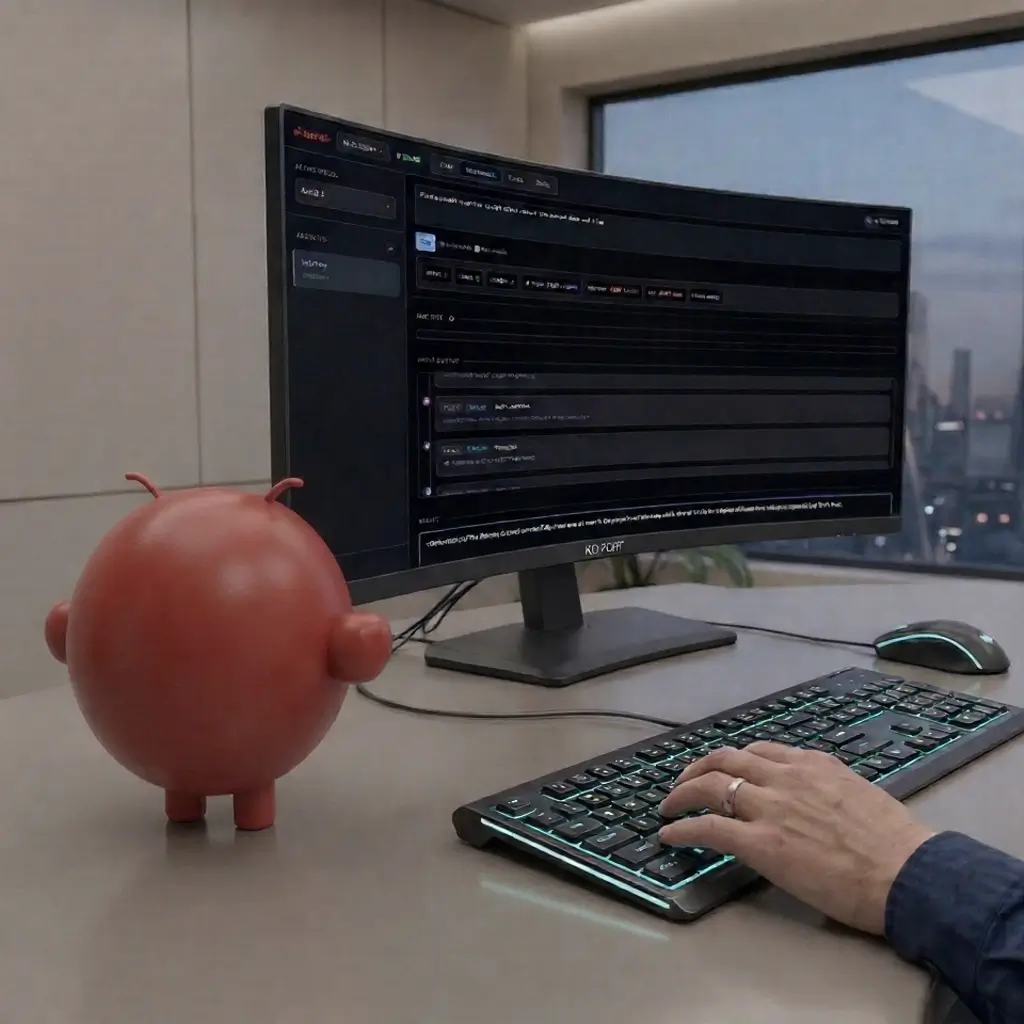
AI is impressive technology — but many people misunderstand what it actually is. It is not intelligence in the human sense. It is a tool that predicts answers based on data. Very powerful, but still just a tool.
Right now, AI is surrounded by a lot of hype. Marketing campaigns, social media drama, new models launching every week. All of this creates the impression that AI can do everything.
The real world is more complicated.
Software Development
When it comes to writing code, every developer working with AI faces a fundamental choice:
You already understand the problem, guide the AI, and review its output critically. The AI accelerates your work.
You accept generated code you don't fully understand — and waste hours trying to fix issues you can't trace.
And here is the real problem: if you don't understand the AI's response, you have no control over the outcome. AI has no accountability. It gives you an answer that sounds confident, but that confidence means nothing.
- Is the generated code correct?
- Is it safe and free of vulnerabilities?
- Is it scalable for production use?
If you want to build a standard app or SaaS product like thousands already exist, AI can genuinely help a lot. It can generate boilerplate code and scaffold database schemas with remarkable speed.
But when you want something special — real custom logic, unique integrations, performance tuning, security hardening, hardware interaction, or complex workflows — things change quickly. You start to see the limitations. Discussing with AI is not like discussing with an experienced engineer. There is no real responsibility and no real-world consequences for wrong output.
Design
In design, the main issue is creativity. AI does not truly create something new. Instead, it connects patterns from training data, mixes existing styles, and recombines what already exists into something that looks novel — but isn't.
AI does not get inspired. It does not feel culture. It does not understand context the way a human designer does.
It is powerful — very powerful — but at its core, it is still pattern generation, not genuine creative thinking.
Research
In research, AI mostly provides common, mainstream answers. Well-known ideas and safe responses dominate its output. If you want something deeper or different, you must ask very clearly and very specifically — and even then, the quality of the result depends heavily on:
- How the model was trained and what data it learned from
- How it is configured and what constraints are in place
- How you ask — the quality of your prompt shapes the answer
The output is always shaped by the system behind it, not by independent reasoning.
AI Is Not "Thinking"
Many people talk about AI as if it thinks. It doesn't. AI works entirely with probabilities — every answer is based on statistical prediction, not understanding.
When it calculates 3 × 3, it does not understand numbers. It uses
learned patterns or calls external tools to arrive at a result.
- No inner mind or self-awareness
- No consciousness or lived experience
- No ability to truly reason — just computation
AI and Web Content
AI can summarize websites and information very nicely. But this capability also changes the landscape. Content gets reused and repackaged, original sources sometimes lose visitors, and context can be reduced or lost entirely.
Information becomes cleaner and shorter — but sometimes also shallower. The depth and nuance that comes from original research and expert writing is not something AI can replicate.
How to Use AI Well
To use AI effectively, you need three things: know what you want, understand what you get, and always question the result.
- Use different models and compare their answers
- Test and verify things yourself — don't assume correctness
- Never trust blindly — always apply your own judgment
AI can absolutely support and accelerate your ideas. But new ideas still come from humans. Experience still matters. And responsibility still matters.
Conclusion
AI is powerful. But it is still a tool. And a tool is only as good as the person using it.